Prompt vs. Fine-Tune: The 2026 LLM Efficiency Showdown
Developers face a critical choice for LLM customization. Dive into the real costs, performance trade-offs, and optimal strategies for prompt engineering vs. fine-tuning.
7 min read360 views
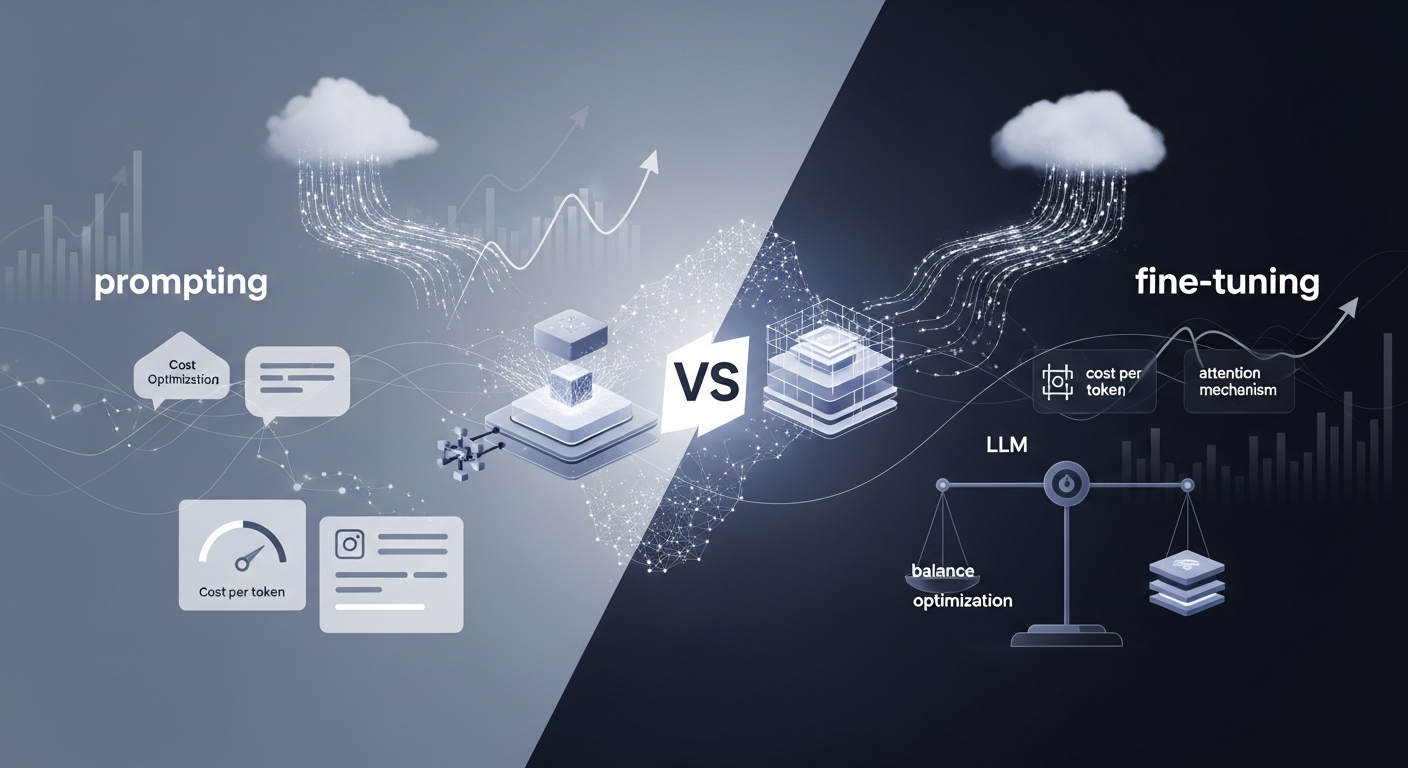
As AI continues to mature, developers are no longer just asking "Can we do it with an LLM?" but "At what cost, and with what performance?" This critical question often boils down to a fundamental architectural decision: should you rely on sophisticated prompt engineering, or invest in fine-tuning a base model? In 2026, with API prices in flux and model capabilities converging, this debate has never been more relevant for engineering teams wrestling with cost anxiety and performance trade-offs.
We've scoured the latest discussions on Hacker News, X (formerly Twitter), and TechCrunch, along with deep dives into recent benchmarks, to bring you a data-backed comparison. Our goal is to equip you with the insights to make a truly informed, money-saving, and technically sound choice for your LLM applications.
The Core Battle: Prompt Engineering vs. Fine-Tuning
See what AI is actually costing your team
Real data from a real engineering team. No sign-up required.
At a high level, both prompt engineering and fine-tuning aim to customize an LLM's behavior for specific tasks. However, they achieve this through vastly different mechanisms, each with its own cost and performance profile.
Prompt Engineering involves crafting smarter inputs – adding few-shot examples, system instructions, or employing techniques like Retrieval-Augmented Generation (RAG). The underlying model remains unchanged. It’s about guiding a general-purpose model to produce desired outputs.
Fine-Tuning, on the other hand, involves training the model further on a specific, labeled dataset, adapting its internal parameters to your unique domain or task. You're teaching the model new knowledge or a new style.
So, which path offers the best ROI for your project? Let's break down the crucial factors.
The Cost Crunch: Where Your Money Goes
This is often the primary driver behind the debate. While prompt engineering appears "free" upfront, and fine-tuning looks expensive, the long-term reality can be surprising.
Upfront Investment: The Entry Barrier
- Prompt Engineering: Virtually no upfront cost. You pay for API calls, but incur no training expenses. This makes it ideal for rapid prototyping and validating ideas quickly.
- Fine-Tuning: Requires a significant initial investment. Expect to spend anywhere from $3,000 to $20,000+ for training using platforms like OpenAI, depending on the model and data volume. Beyond just the compute, there's the cost of gathering and labeling extensive, high-quality training data, which often needs thousands of examples.
Per-Query Costs: The Scaling Trap
This is where the narrative shifts, especially at scale.
- Prompt Engineering: Your per-query cost can be higher, especially if you're relying on longer, more complex prompts or using premium models like GPT-4 or Claude Opus for every interaction. Each token in your prompt and the model's response contributes to the bill. "Complex prompts can increase token usage".
- Fine-Tuning: While expensive upfront, fine-tuned models can lead to lower per-use costs because they require shorter prompts and fewer tokens for equivalent (or even superior) results. The model has "learned" your domain, reducing the need for extensive in-context examples.
The Crossover Point: For high-volume applications processing millions of requests monthly, fine-tuning typically becomes the more economical choice in the long run. If your application generates fewer than 100,000 queries or is still in the early prototype stage, prompt engineering often makes more financial sense.
Performance Pains: Speed, Accuracy, and Control
Beyond raw cost, how do these methods stack up when it comes to getting the job done right and fast?
Speed and Latency: Every Millisecond Counts
- Prompt Engineering: Iteration speed is incredibly fast – hours or days to experiment and refine prompts. However, at inference, large prompts can increase response times and API latency, which can hurt performance in real-time applications.
- Fine-Tuning: The initial training and iteration cycle is slow, potentially taking 2-6 weeks. Once deployed, however, fine-tuned models can run up to 70% faster for narrow, specialized tasks because they have absorbed domain knowledge directly, reducing inference time. This "low latency during inference" is a significant advantage for scale.
Accuracy and Consistency: Precision vs. Flexibility
- Prompt Engineering: Offers flexibility, but can be brittle. Small changes in input might lead to wildly different outputs. While "good prompt engineering often matches fine-tuned performance" for general tasks, it's less reliable for highly specialized or compliance-sensitive tasks.
- Fine-Tuning: Ideal for repetitive, structured, or compliance-sensitive tasks where reliability and consistency are key. Fine-tuned models can achieve 28.3% higher accuracy on domain-specific tasks compared to prompt-only approaches. They are also better for tasks requiring structured outputs (e.g., JSON, classifications).
Control and Data Requirements: The Training Data Imperative
- Prompt Engineering: Works with the model's existing knowledge, requiring minimal additional data – often just a few dozen well-crafted examples. You have less control over the model's internal workings.
- Fine-Tuning: Depends on large, clean, domain-specific datasets – usually 10,000+ carefully labeled examples. The quality of your fine-tuned model is directly tied to the quality and quantity of your training data. This offers deep control over the model's behavior for specific tasks.
Making the Right Choice: A Developer's Decision Framework
Given these trade-offs, how do you decide? Here's a decision framework for 2026:
Choose Prompt Engineering if:
- You're in the early stages of a project or still exploring use cases.
- You don't have a large, labeled dataset readily available.
- Your application handles flexible, multi-domain tasks.
- Rapid iteration and quick deployment are paramount.
- Your traffic volume is low to moderate.
- You're using RAG for retrieval, which is a powerful form of prompt engineering.
Choose Fine-Tuning if:
- Your use case is narrow, stable, and high-volume.
- You require highly structured, consistent outputs (e.g., JSON).
- Lower latency and cost at scale are critical.
- You have hundreds or thousands of high-quality, labeled training examples.
- Domain-specific accuracy and reliability are non-negotiable (e.g., medical, legal).
The Hybrid Approach: The Best of Both Worlds
Many production systems now leverage both techniques. You can fine-tune a model for foundational domain knowledge and then use prompt engineering to handle specific variations, adjust tone, or inject real-time context. This approach provides the consistency of fine-tuning with the flexibility of prompt engineering, often yielding optimal results.
Navigating LLM Costs with CostLens
Regardless of whether you choose prompt engineering, fine-tuning, or a hybrid strategy, managing and optimizing your LLM costs is non-negotiable. This is where tools like CostLens become indispensable.
Our CostLens Node.js SDK empowers developers to:
- Track Costs in Real-Time: Get immediate visibility into your LLM spending, whether it's token consumption from prompt engineering or inference costs from your fine-tuned models.
- Enforce Budgets: Set spending limits and receive alerts before you hit costly overruns.
- Intelligent Model Routing: Automatically route requests to the most cost-effective and performant model for each task. If you have both a fine-tuned model and a cheaper, general-purpose model, CostLens can intelligently decide which to use based on your configured rules and budget.
- Unified Analytics: Gain a holistic view of your LLM usage, performance, and spending across all providers and models, helping you identify further optimization opportunities.
For instance, consider implementing a dynamic routing strategy where routine requests (which can be handled by a cheaper, smaller model or a well-engineered prompt) are automatically directed away from your more expensive, fine-tuned models or premium APIs.
// Example (conceptual) of CostLens intelligent routing
const CostLens = require('@costlens/sdk');

async function processRequest(prompt, taskType) {
  const router = new CostLens.Router();

  // Define your routing logic based on task complexity, cost thresholds, etc.
  const model = await router.getOptimalModel({
    task: taskType,
    prompt: prompt,
    costBudget: 0.01 // Max cost per request
  });

  if (model.name === 'my-fine-tuned-model') {
    // Route to your fine-tuned model via its API
    return callFineTunedAPI(prompt);
  } else if (model.name === 'gpt-5-nano') {
    // Route to a cheaper API model with specific prompt engineering
    const optimizedPrompt = `Always respond concisely. ${prompt}`;
    return callOpenAIAPI(optimizedPrompt, 'gpt-5-nano');
  } else {
    // Fallback or another strategy
    return callDefaultAPI(prompt);
  }
}

// Imagine calling this from your application logic:
// processRequest("Summarize this document.", "summarization");
// processRequest("Generate a legal brief.", "legal-drafting");
By integrating CostLens, you transform the "Prompt vs. Fine-Tune" debate from a static choice into a dynamic, optimized strategy, ensuring you get the best performance for your dollar.
Conclusion
In 2026, the decision between prompt engineering and fine-tuning is rarely an "either/or." It's about understanding your use case, data availability, performance requirements, and crucially, the evolving cost landscape. While fine-tuning offers specialized performance and long-term cost savings at scale, prompt engineering provides agility and low upfront investment. Many developers find a powerful hybrid approach to be the most effective.
The market has shifted: "Models that cost $60 per million tokens in early 2024 now have equivalents costing $1-2 per million tokens. Some tasks that used to cost dollars now cost fractions of a cent." This price collapse means that intelligent model selection and cost observability are more critical than ever. Developers who master this balance, leveraging tools like CostLens for dynamic routing and real-time insights, will be the ones who build truly efficient and scalable AI applications. Don't leave money on the table or sacrifice performance – make data-backed choices for your LLM stack.
Track your AI costs automatically
Connect GitHub in 30 seconds. See your AI ROI report instantly.
llm costsprompt engineeringfine-tuningperformanceoptimizationai strategy
See what AI is actually costing your team
Real data from a real engineering team. No sign-up required.